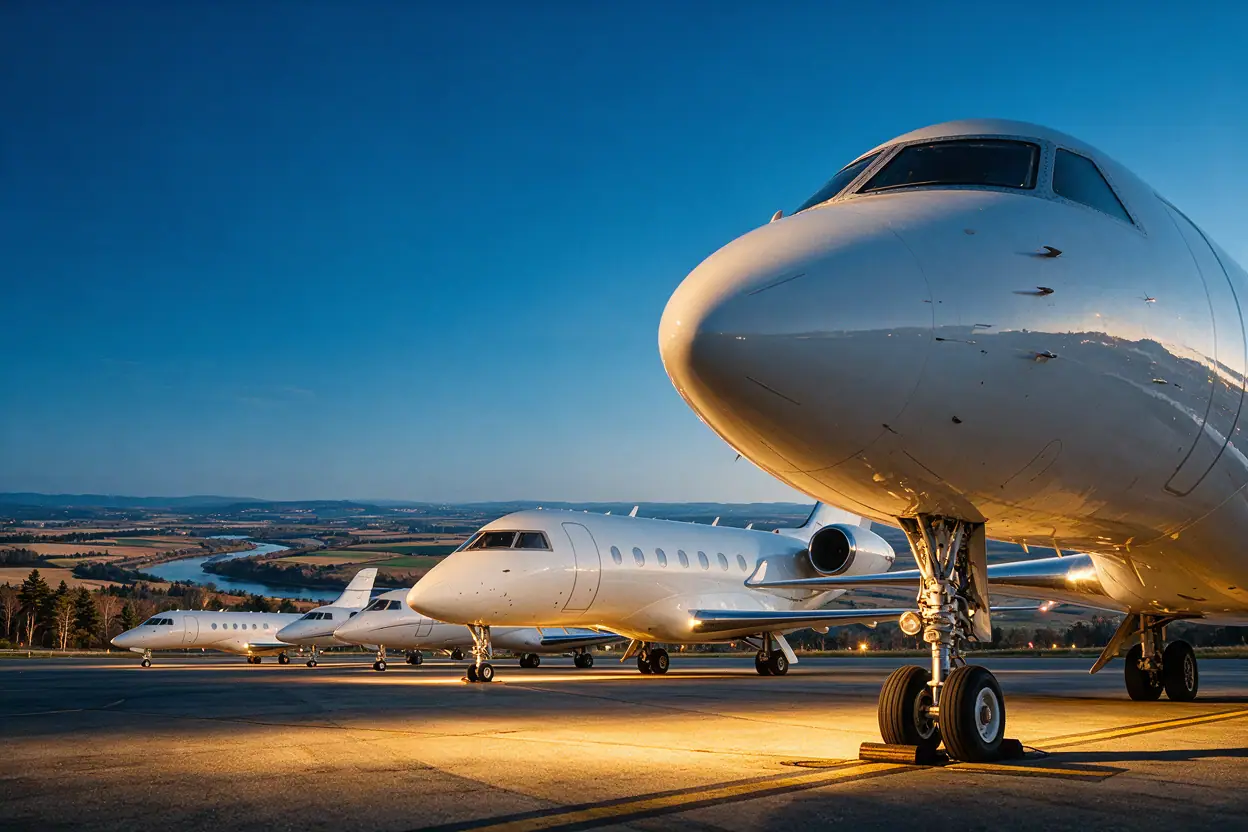
Types of private planes to charter
Choosing among types of private planes to charter starts with three numbers: passengers, range, runway. A light jet cruises near 430 knots with a typical range of 1,400 nautical miles. The category you pick sets the hourly rate and the airports you can use.
- Start
- Planes
The fleet categories below cover turboprops, light jets, midsize jets, super-midsize jets, and heavy jets. Each class has a distinct mix of cabin size, range, and runway performance, and each is priced by the hour rather than by the seat. That structure means a short flight in a light jet is priced for the aircraft, not for how many people are on board. For a group of four to six flying under two hours, the smaller categories usually make the most sense; for transcontinental or international legs, the larger jets earn their cost.
Runway length and density altitude decide which types of private planes to charter into a given airport. Mountain airports such as Centennial near Denver sit at 5,885 feet, and its peak density altitude reaches 9,800 feet, so a turboprop or a light jet may need a longer runway or a lighter load than at sea level. Coastal fields such as Teterboro and Miami-Opa Locka sit near sea level, where runway performance is rarely the limiting factor. Prices shown on this page are estimates; a charter operator confirms the final quote for your dates.
US fleet count for these aircraft
Valid US registrations on the FAA registry cover 18,165 business jets and 13,001 turboprops; fractional ownership accounts for 905 of the jets, and the median jet was built in 2008.
| Model | Grouped by | US total | Top registration state |
|---|---|---|---|
| Pilatus PC-12 NGX | Pilatus PC-12 series | 1,426 | Texas (124) |
| Daher TBM 960 | TBM 700-960 series | 987 | Delaware (117) |
| Pilatus PC-24 | Pilatus PC-24 | 200 | New Hampshire (22) |
| HondaJet Elite II | HondaJet series | 236 | North Carolina (38) |
| Cessna Citation XLS+ | Citation Excel/XLS series | 733 | Texas (80) |
| Cessna Citation Latitude | Citation Latitude | 392 | Utah (12) |
| Cessna Citation X+ | Citation X series | 283 | North Carolina (46) |
| Bombardier Challenger 350 | Challenger 300/350 series | 868 | Utah (120) |
| Dassault Falcon 900LX | Falcon 900 series | 403 | Texas (48) |
| Gulfstream G450 | Gulfstream IV/G450 series | 610 | California (86) |
Source: FAA aircraft registry, active registrations only, figures as of Nov 2, 2026. Each model is tallied under its type-certificate family.
States leading in business jet count
| US state | On record |
|---|---|
| Texas | 1,671 |
| Utah | 1,578 |
| Florida | 1,569 |
| Delaware | 1,556 |
| California | 1,044 |
| Ohio | 675 |
| Tennessee | 649 |
| North Carolina | 479 |
| New York | 460 |
| Kansas | 399 |
How to choose the right aircraft type
The first filter is the route itself. New York to Los Angeles at 2,129 nautical miles sits beyond the typical range of a light jet at 1,400 nautical miles, so that leg calls for a super-midsize or heavy jet; a light jet would need a fuel stop. A route like Los Angeles to Las Vegas at 199 nautical miles fits every jet class in the fleet. Short flights favor light jets and turboprops, where hourly rates are lowest, while transcontinental legs favor super-midsize jets and heavy jets.
The second filter is the airport. At Centennial Airport near Denver, a peak density altitude of 9,800 feet can limit a turboprop or light jet on a hot day, so a larger aircraft or a lighter load may be the answer. Sea-level fields such as Teterboro, with a longest runway of 6,997 feet, and Miami-Opa Locka, at 8,002 feet, rarely impose that limit. If your group is six or fewer and the flight is under two hours, then a turboprop or light jet is usually the lower-cost choice.
Aircraft types on part 135 certificates
The FAA's Part 135 Operators and Aircraft list, dated Mar 25, 2026, shows the Pilatus PC-12 as the most listed business aircraft type with 450 airframes, followed by the Bombardier Challenger 300/350 at 414. Those counts help gauge how many aircraft of a type are available for charter quotes. The table below ranks ten business types by listed airframes.
| Aircraft type | Class | Listed on Part 135 certificates |
|---|---|---|
| Pilatus PC-12 | turboprop | 450 |
| Bombardier Challenger 300/350 | super-midsize jet | 414 |
| Learjet 35/45/60 | light and midsize jet | 344 |
| Beechcraft King Air 200/350 | turboprop | 333 |
| Embraer Phenom 300 | light jet | 326 |
| Cessna Citation CJ series | light jet | 299 |
| Cessna Citation Excel/XLS | midsize jet | 273 |
| Cessna Citation Latitude | midsize jet | 249 |
| Gulfstream G-V/G550/G650 family | heavy jet | 240 |
| Bombardier Global | heavy jet | 217 |
Source: FAA, Part 135 Operators and Aircraft, list dated Mar 25, 2026. Business aircraft types only.
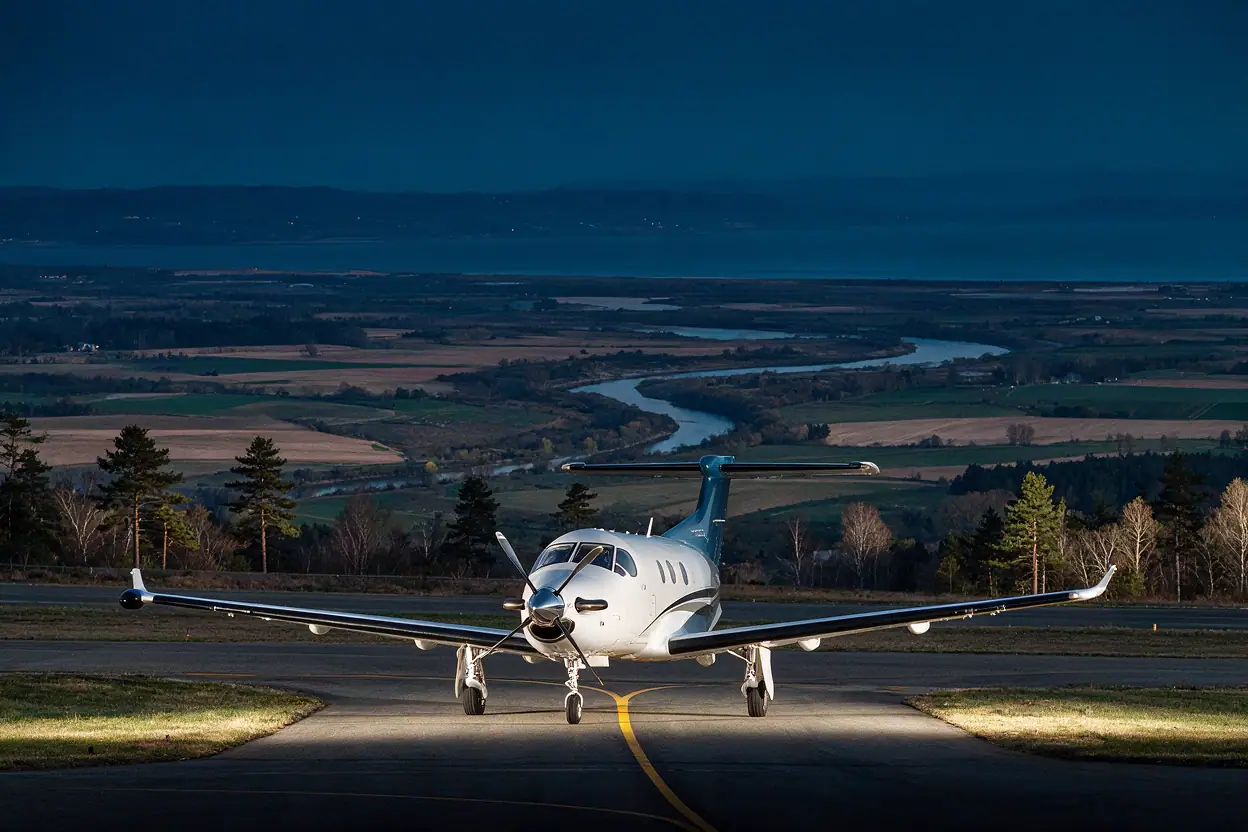
Turboprop
Turboprops such as the Pilatus PC-12 NGX and Daher TBM 960 carry six passengers at 290 to 330 knots and typically cover 1,500 nautical miles. Hourly rates run about $2,200 to $3,500, the lowest of the categories. Their short-field ability helps at high-elevation airports, and the PC-12's 1,800-nautical-mile range covers many regional routes without a fuel stop.
Pilatus PC-12 NGX
- 6 seats
- 290 kt cruise
- 1,800 nm range
The Pilatus PC-12 NGX is a single-engine turboprop that seats six at 290 knots with a range of 1,800 nautical miles. Its cabin stands 4 feet 10 inches tall and 16 feet 11 inches long, with 40 cubic feet of baggage space. The PC-12 is the most common type on the FAA's Part 135 list, with 450 aircraft listed as of Mar 25, 2026, which helps availability.
Daher TBM 960
- 6 seats
- 330 kt cruise
- 1,730 nm range
The Daher TBM 960 is a single-engine turboprop seating six at 330 knots, the fastest cruise in the turboprop class here, with a range of 1,730 nautical miles. The cabin is 4 feet tall and 13 feet 3 inches long, with 32 cubic feet of baggage space. It suits owners and charterers who value speed on regional routes over cabin room.
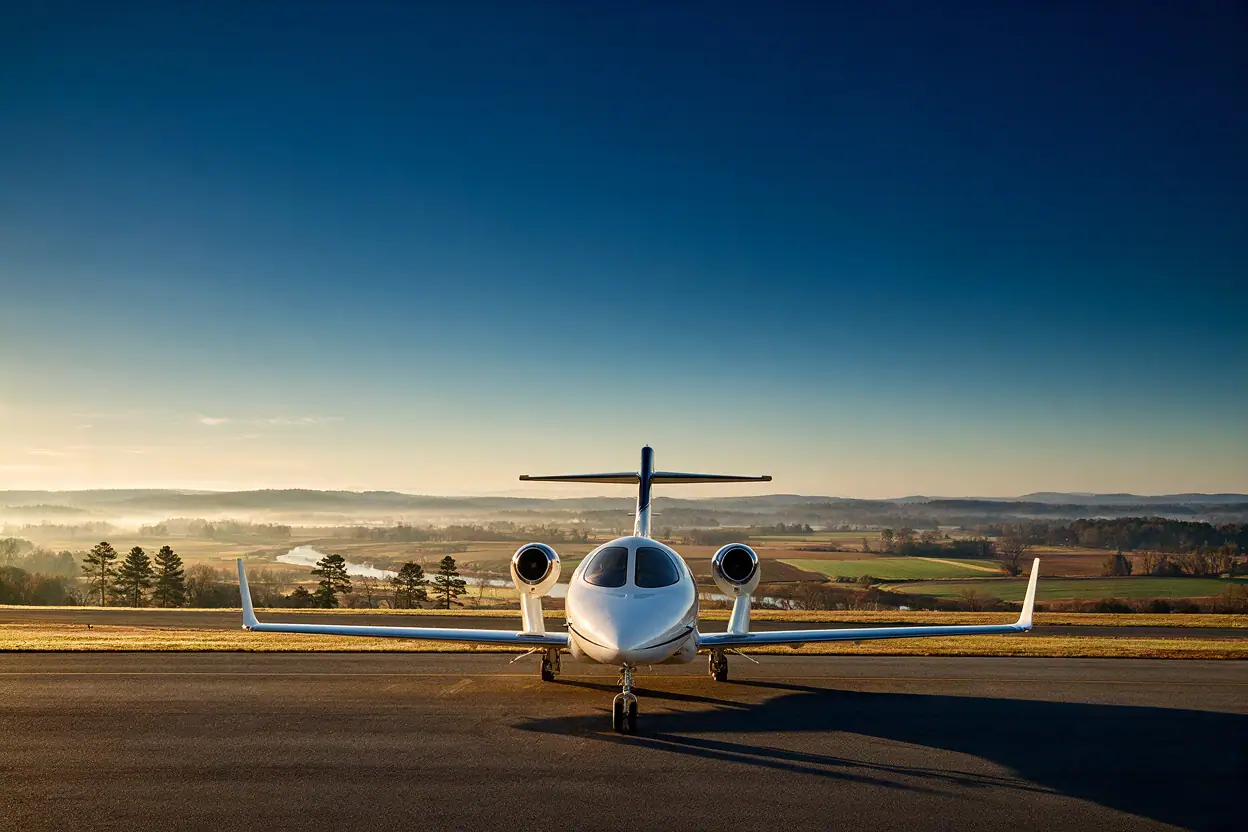
Light jet
Light jets such as the HondaJet Elite II and Pilatus PC-24 seat five to eight and cruise near 430 knots with a typical range of 1,400 nautical miles. Hourly rates are about $3,800 to $5,800. They suit short hops like Los Angeles to Las Vegas at 199 nautical miles, and they use thousands of airports that airlines do not serve.
Pilatus PC-24
- 8 seats
- 440 kt cruise
- 2,000 nm range
The Pilatus PC-24 is a light jet seating eight at 440 knots with a range of 2,000 nautical miles. Its cabin is 5 feet 1 inch tall and 23 feet long, and baggage space totals 90 cubic feet. The PC-24's runway performance is unusually short for a jet, which helps at airports with shorter runways.
HondaJet Elite II
- 5 seats
- 422 kt cruise
- 1,550 nm range
The HondaJet Elite II is a light jet seating five at 422 knots with a range of 1,550 nautical miles. The cabin is 4 feet 10 inches tall and 17 feet 9 inches long, with 66 cubic feet of baggage space. Its 3,500-foot takeoff distance is among the longer ones in this fleet list, so confirm runway length at smaller fields.
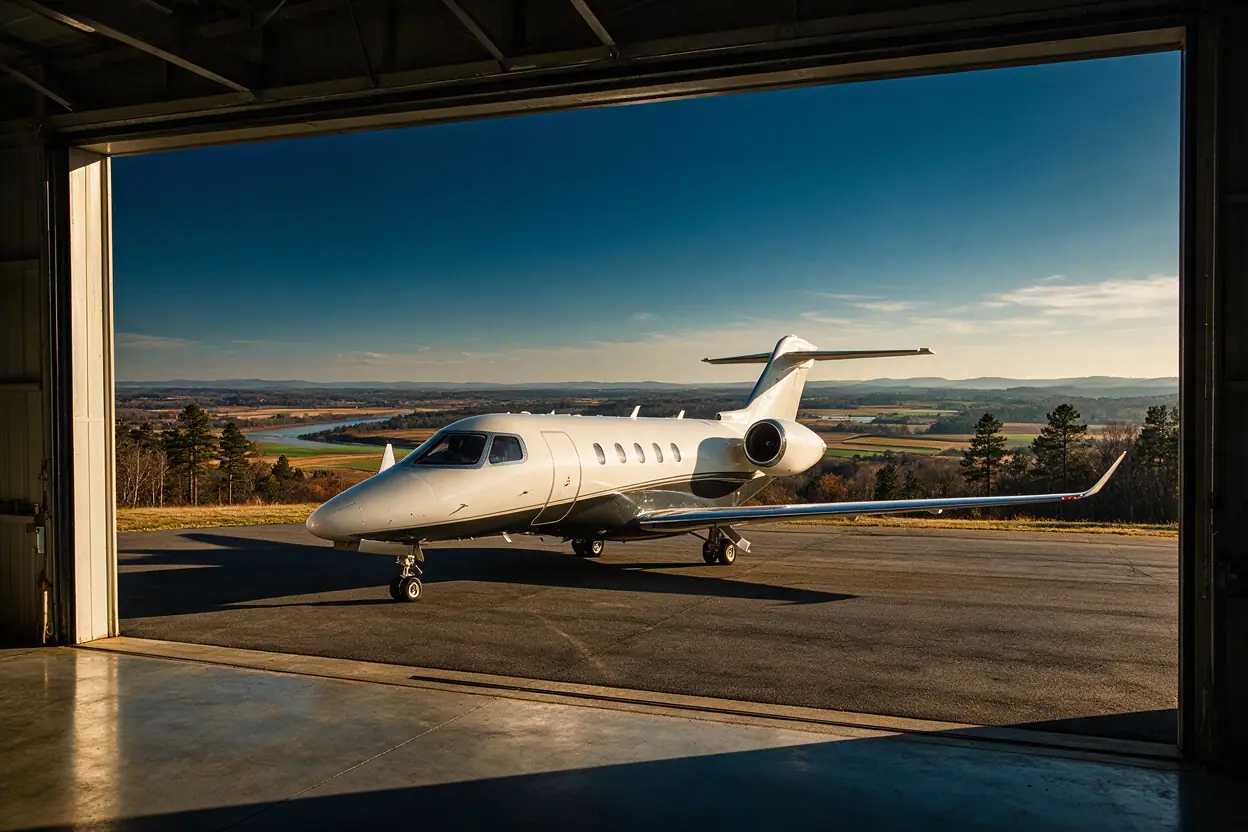
Midsize jet
Midsize jets such as the Cessna Citation XLS+ and Citation Latitude carry seven to nine passengers at roughly 440 knots and typically range 2,100 nautical miles. Hourly rates run about $5,200 to $7,800. A stand-up cabin and more baggage space make this class a common choice for two- to three-hour flights with a full load.
Cessna Citation XLS+
- 8 seats
- 441 kt cruise
- 2,100 nm range
The Cessna Citation XLS+ is a midsize jet seating eight at 441 knots with a range of 2,100 nautical miles. The cabin stands 5 feet 8 inches tall and 18 feet 6 inches long, with 90 cubic feet of baggage space. It covers routes like New York to Miami at 949 nautical miles in about 2 hours 34 minutes.
Cessna Citation Latitude
- 9 seats
- 446 kt cruise
- 2,700 nm range
The Cessna Citation Latitude is a midsize jet seating nine at 446 knots with a range of 2,700 nautical miles. Its cabin is 6 feet tall and 21 feet 9 inches long, with 127 cubic feet of baggage space. The stand-up cabin and longer range make it a candidate for coast-to-coast flights with a full load.
Super-midsize jet
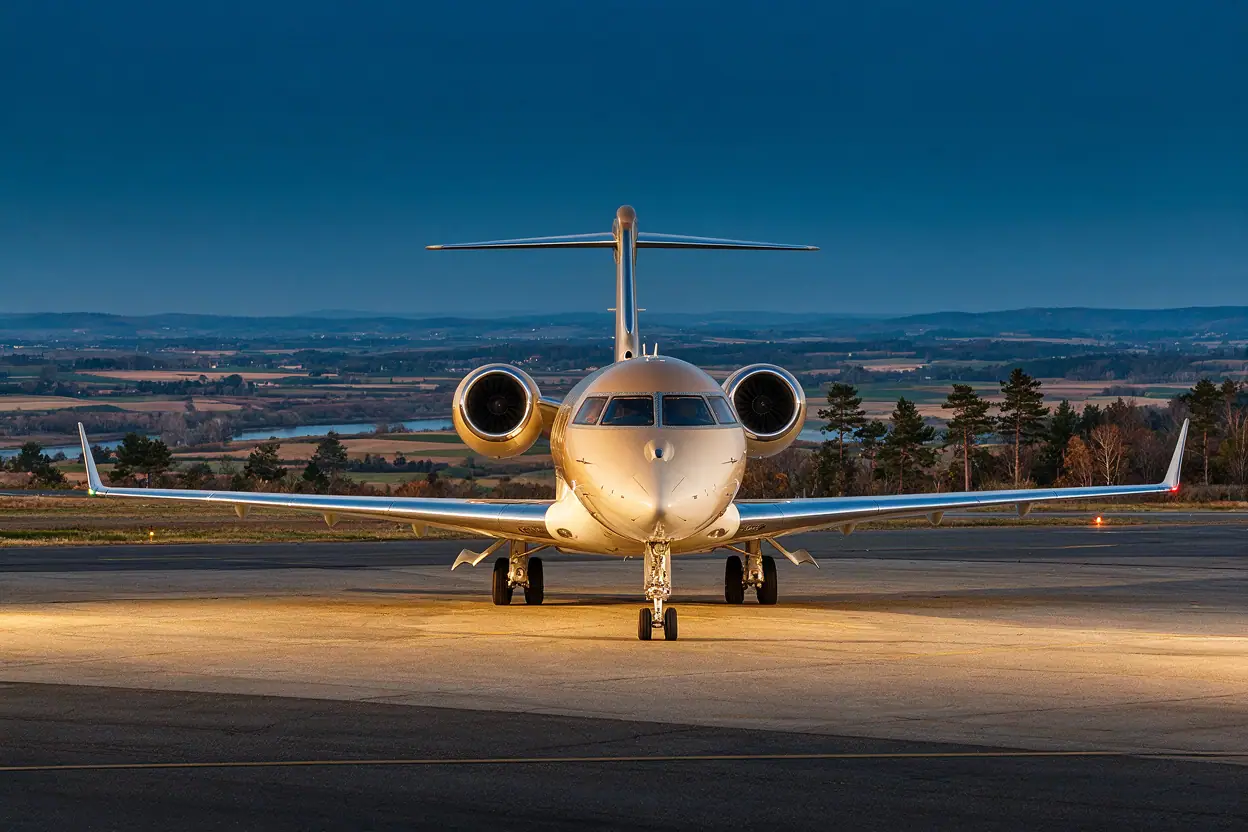
Super-midsize jets such as the Bombardier Challenger 350 and Cessna Citation X+ carry eight to ten at about 470 knots and typically range 3,200 nautical miles. Hourly rates are about $7,200 to $10,000. The class covers transcontinental routes like New York to Los Angeles at 2,129 nautical miles without a fuel stop.
Cessna Citation X+
- 9 seats
- 527 kt cruise
- 3,460 nm range
The Cessna Citation X+ is a super-midsize jet seating nine at 527 knots, the fastest cruise speed in this fleet list, with a range of 3,460 nautical miles. The cabin is 5 feet 8 inches tall and 25 feet 2 inches long, with 82 cubic feet of baggage space. Speed matters on long transcontinental routes.
Bombardier Challenger 350
- 10 seats
- 470 kt cruise
- 3,200 nm range
The Bombardier Challenger 350 is a super-midsize jet seating ten at 470 knots with a range of 3,200 nautical miles. The cabin stands 6 feet tall and 25 feet 2 inches long, with 106 cubic feet of baggage space. The Challenger 300/350 family is the second most common type on the FAA Part 135 list, with 414 aircraft as of Mar 25, 2026.
Heavy jet
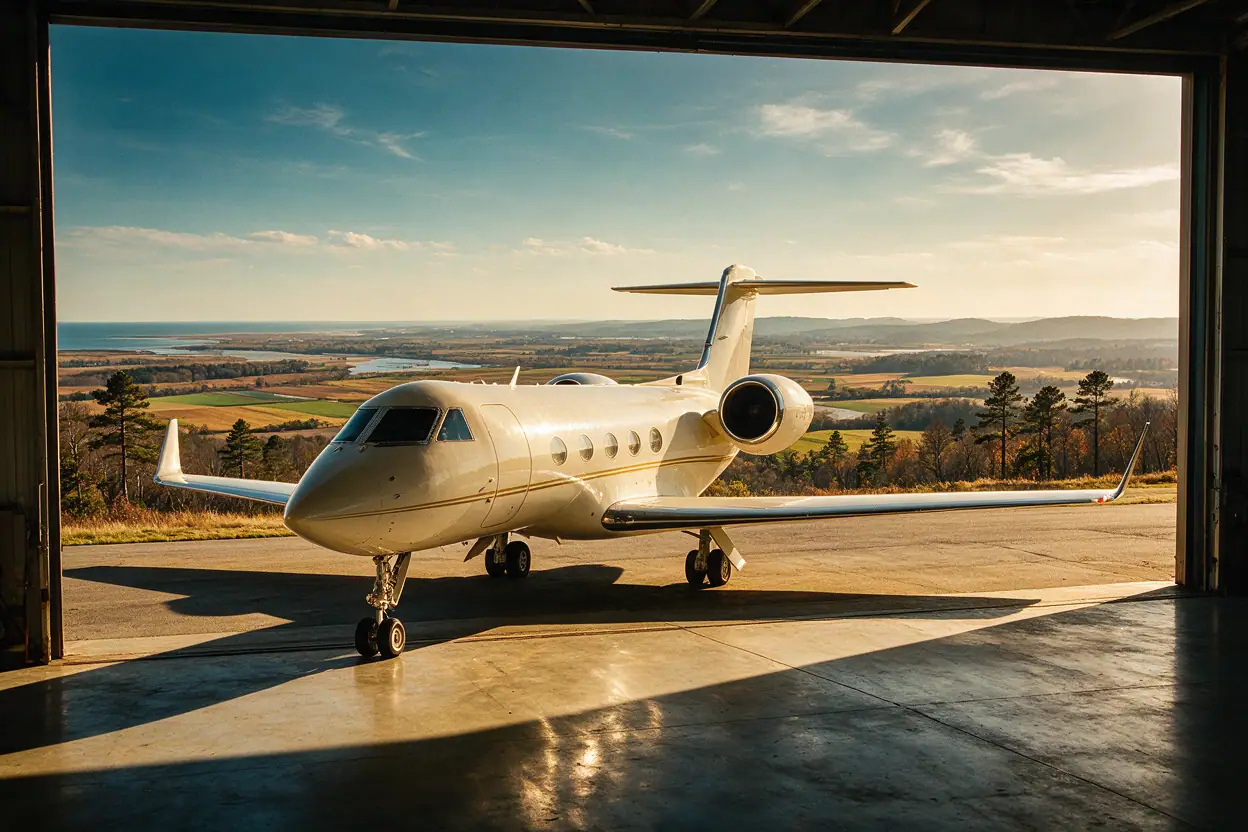
Heavy jets such as the Gulfstream G450 and Dassault Falcon 900LX carry ten to fourteen at about 470 knots and typically range 4,000 nautical miles. Hourly rates run about $9,500 to $14,500. They suit international legs and larger groups, with cabins six feet or taller and baggage compartments above 120 cubic feet.
Dassault Falcon 900LX
- 12 seats
- 459 kt cruise
- 4,750 nm range
The Dassault Falcon 900LX is a heavy jet seating twelve at 459 knots with a range of 4,750 nautical miles, the longest in this fleet list. The cabin is 6 feet 2 inches tall and 33 feet 2 inches long, with 127 cubic feet of baggage space. Its range suits long international legs and larger groups.
Gulfstream G450
- 14 seats
- 476 kt cruise
- 4,350 nm range
The Gulfstream G450 is a heavy jet seating fourteen at 476 knots with a range of 4,350 nautical miles. The cabin is 6 feet 2 inches tall and 45 feet 1 inch long, the longest here, with 169 cubic feet of baggage space. The large cabin and baggage capacity suit groups of ten or more on long flights.
FAQ
What are the different types of private planes to charter?
The main categories are turboprops, light jets, midsize jets, super-midsize jets, and heavy jets. Turboprops typically carry six to eight passengers at about 300 knots with a range near 1,500 nautical miles. Light jets carry four to seven at about 430 knots with a range near 1,400 nautical miles. Midsize jets carry seven to nine, super-midsize eight to ten, and heavy jets ten to fourteen, with ranges rising to 4,000 nautical miles. Each class is priced by the hour, and quotes are estimates until an operator confirms them.
What are the 7 categories of aircraft?
In common charter and regulatory usage, aircraft categories include airplane, rotorcraft, glider, lighter-than-air, powered-lift, powered parachute, and weight-shift-control. For charter planning, the useful split is by class rather than category: turboprops, light jets, midsize jets, super-midsize jets, and heavy jets. On this site the fleet list covers ten models across those five classes, from the Pilatus PC-12 NGX turboprop to the Gulfstream G450 heavy jet.
What's the average cost to charter a private plane?
Hourly rates range from about $2,200 to $3,500 for turboprops, $3,800 to $5,800 for light jets, $5,200 to $7,800 for midsize jets, $7,200 to $10,000 for super-midsize jets, and $9,500 to $14,500 for heavy jets. A short leg like Los Angeles to Las Vegas at 199 nautical miles prices at about $4,000 to $6,000 in a light jet. These are estimates, and an operator confirms the final figure for your dates.
Which jet does Elon Musk use?
Public flight-tracking coverage has reported a Gulfstream G650 in connection with Elon Musk, but this site does not confirm individual aircraft ownership and lists no G650 in its fleet data. The nearest heavy jet in the fleet list here is the Gulfstream G450, which seats fourteen at 476 knots with a range of 4,350 nautical miles. For a group of that size on a long leg, a heavy jet is the class to price.
Which types of private planes to charter work for international flights?
International legs generally call for super-midsize jets or heavy jets. The super-midsize class typically ranges 3,200 nautical miles, and heavy jets reach 4,000 nautical miles, so a route like Miami to Nassau at 161 nautical miles fits any class while longer legs do not. On international flights, CBP processing applies at the port of entry, and a light jet may need a fuel stop on routes beyond its 1,400-nautical-mile typical range.
Do turboprops and light jets use different airports than heavy jets?
Yes, runway length and density altitude change the list of usable airports. Centennial Airport near Denver has a peak density altitude of 9,800 feet, which can limit a turboprop or light jet on a hot day, while Teterboro's 6,997-foot longest runway and Miami-Opa Locka's 8,002-foot runway rarely constrain a jet. Heavy jets like the Gulfstream G450 and Falcon 900LX need more runway but add range and cabin space. The class you choose should match the airports on your route.