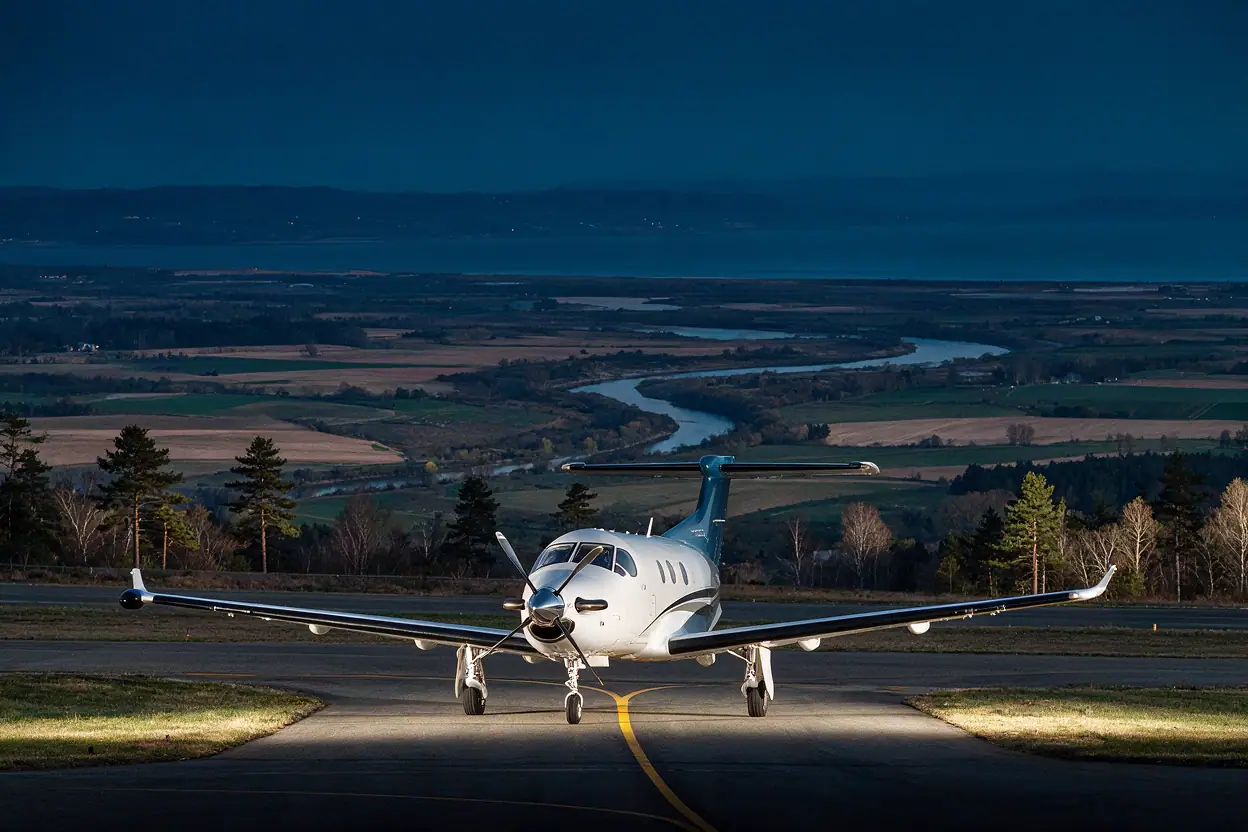
Turboprop Private Plane For Charter
A turboprop private plane for charter sits between a light jet and a long highway drive. Hourly rates run $2,200 to $3,500, and the class cruises around 300 knots with 6 to 8 seats. Short hops are where this class earns its keep.
- $2,200–$3,500per flight hour
- 6-8seats occupied
- 1,500 nmusual range
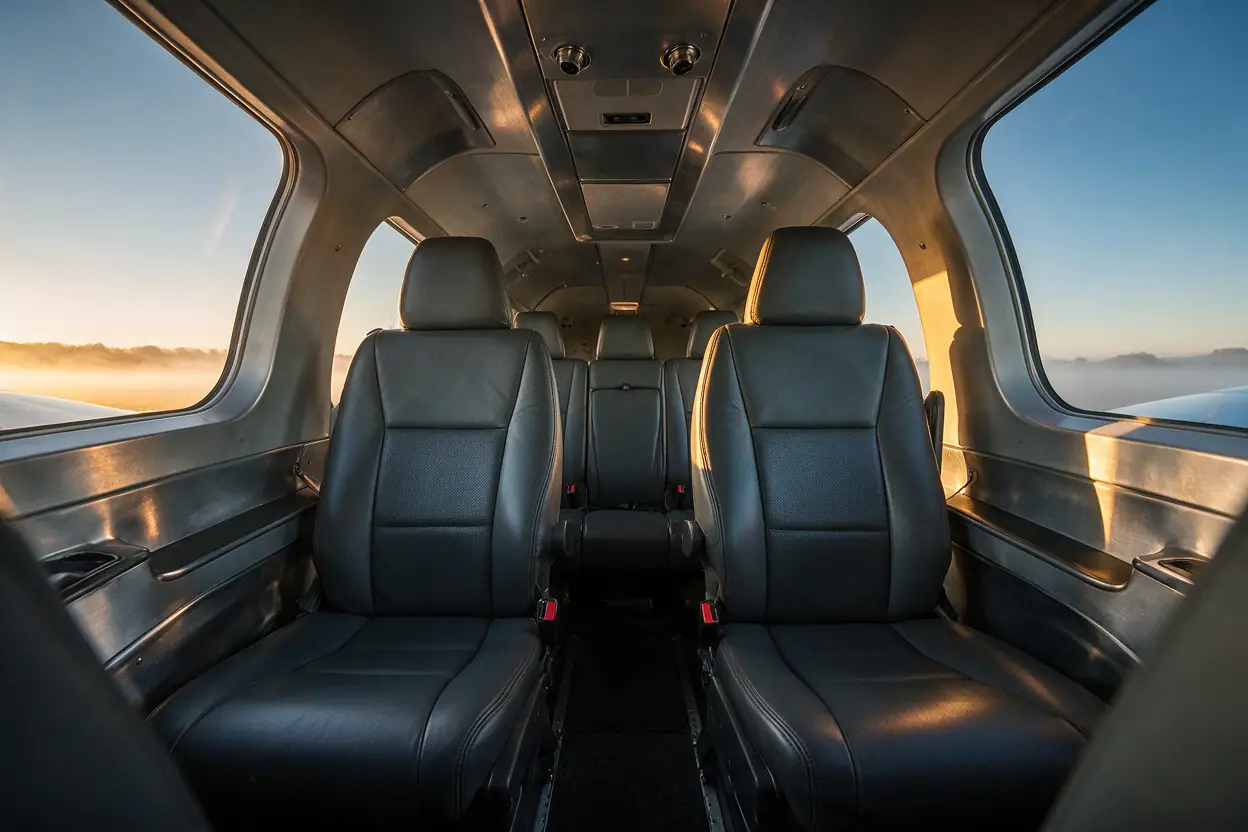
A turboprop private plane for charter seats 6 to 8 passengers and cruises near 300 knots, with a typical range of about 1,500 nautical miles. That puts a single-engine turboprop in a useful gap: faster than a piston twin, cheaper per hour than most jets, and able to use runways a jet would skip. Hourly rates for the class run $2,200 to $3,500. Landing fees, overnight crew costs and de-icing in winter can sit outside a quote, so ask what the estimate includes before you compare two quotes side by side.
The class splits into two practical shapes. The Pilatus PC-12 NGX carries 6 passengers in a cabin 4 ft 10 in tall and 16 ft 11 in long, with 40 cu ft of baggage, and it is the one to look at when the trip is mostly people and luggage. The Daher TBM 960 carries 6 at 330 knots with 32 cu ft of baggage, and it is the faster of the two. A turboprop private plane for charter trades cabin width for short-runway access on regional trips. Neither is a stand-up cabin, and on a trip much past 900 nautical miles the leg count starts to matter more than the hourly rate.
Pilatus PC-12 NGX
- 6 seats
- 290 kt cruise
- 1,800 nm range
- 40 cu ft baggage
- 1,426 registration in US
The PC-12 NGX is the volume pick in this class. Six passengers sit in a cabin 4 ft 10 in tall and 16 ft 11 in long, which is roomier than most turboprops at this price, and 40 cu ft of baggage handles a family's worth of duffels. It cruises at 290 knots and flies up to 1,800 nautical miles, so New York to Miami at 949 nautical miles fits nonstop in about 3h 37m. Typical quotes for that route fall between $8,000 and $12,500.
Daher TBM 960
- 6 seats
- 330 kt cruise
- 1,730 nm range
- 32 cu ft baggage
- 987 registration in US
The TBM 960 is the speed option. It carries 6 passengers at 330 knots, the fastest cruise in the turboprop class, and reaches 1,730 nautical miles with 32 cu ft of baggage. The cabin is 4 ft tall and 13 ft 3 in long, which is tighter than the PC-12's, so this one suits travelers who value time over elbow room. Chicago to New York, 619 nautical miles, runs about 2h 28m with quotes in the $5,500 to $8,500 range.
When a turboprop beats a jet
- Short regional legs under roughly 300 nautical miles, where a turboprop private plane for charter spends less time climbing and descending than a jet does. Los Angeles to Las Vegas covers 199 nautical miles in about 1h 00m, and Los Angeles to San Francisco runs 279 nautical miles in about 1h 17m. On trips that short, the difference between classes is a few minutes, not an hour.
- Airports with short or unpaved runways, where turboprops can use fields that jets cannot. Mountain towns, island strips and small county airports across the US often fall below what a jet needs, and the turboprop was built for exactly that. If the closest airport to your destination has a short runway, then the turboprop may be the only charter class that lands you there without a long drive.
- Trips where six passengers and normal luggage are the whole requirement, with no need for a stand-up cabin. The PC-12 NGX and TBM 960 both seat 6, so a group of four to six travels comfortably and a group of eight is a stretch. If your party is larger than six, then plan on a second aircraft or a move up to a jet class.
- Miami to Nassau, a 161 nautical mile hop that runs about 0h 52m at a quoted $2,200 to $3,500. International legs like this one need a stop at Customs and Border Protection on the way back, and the turboprop's short-field ability opens island strips that jets skip. If your return leg clears CBP at a smaller field, then build the customs stop into the schedule rather than the flight time.
Where turboprop range stops
Range is the first constraint. A turboprop private plane for charter typically covers about 1,500 nautical miles, and the aircraft here top out near 1,800. New York to Los Angeles is 2,129 nautical miles, which means a fuel stop and roughly 8h 30m of flying against quotes of $18,500 to $30,000. If your trip runs past about 1,200 nautical miles, then a jet usually wins on total travel time even at a higher hourly rate.
Cabin height is the second. Neither aircraft here stands up, and the TBM 960's cabin is 4 ft tall, so tall passengers should expect to sit for the whole leg. Winter weather matters too: turboprops handle ice-protected flight well, but de-icing and routing around fronts add cost and time on northern routes in January and February.
Turboprop pricing on leading routes
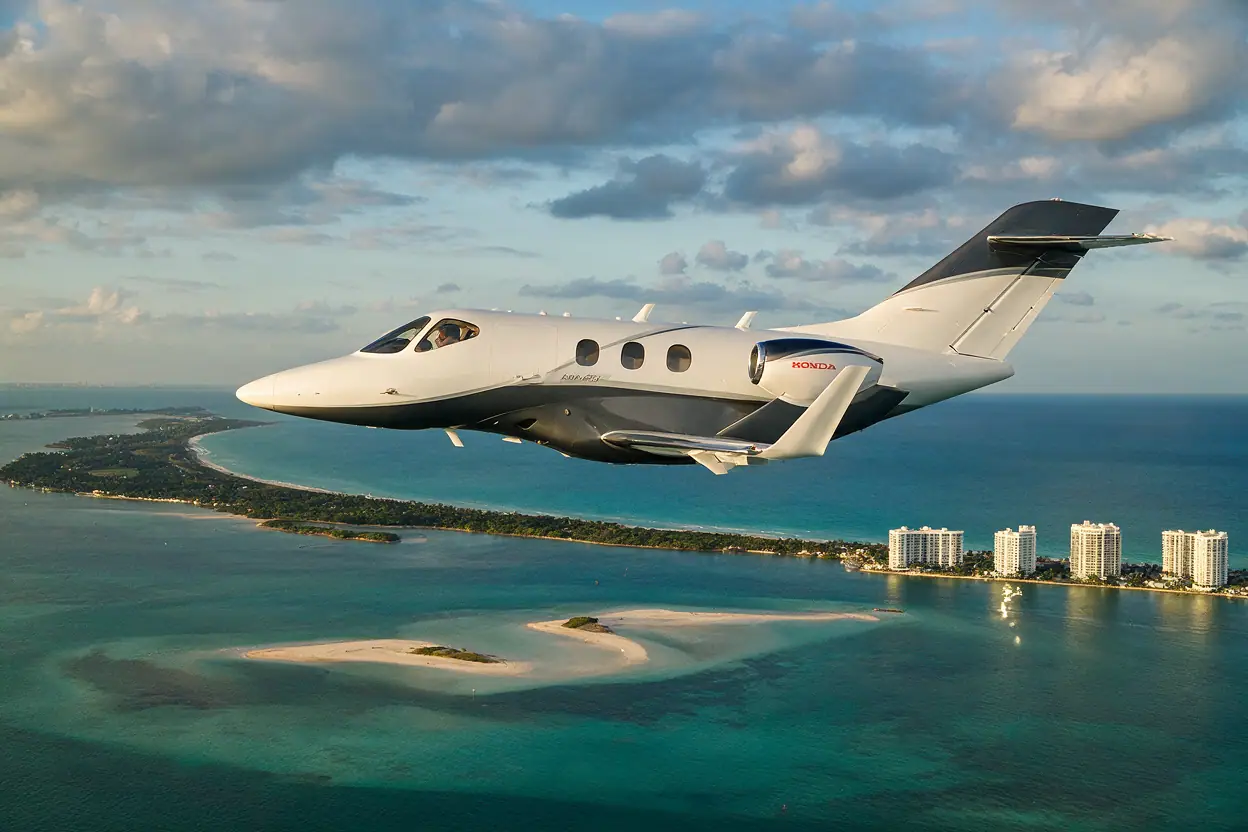
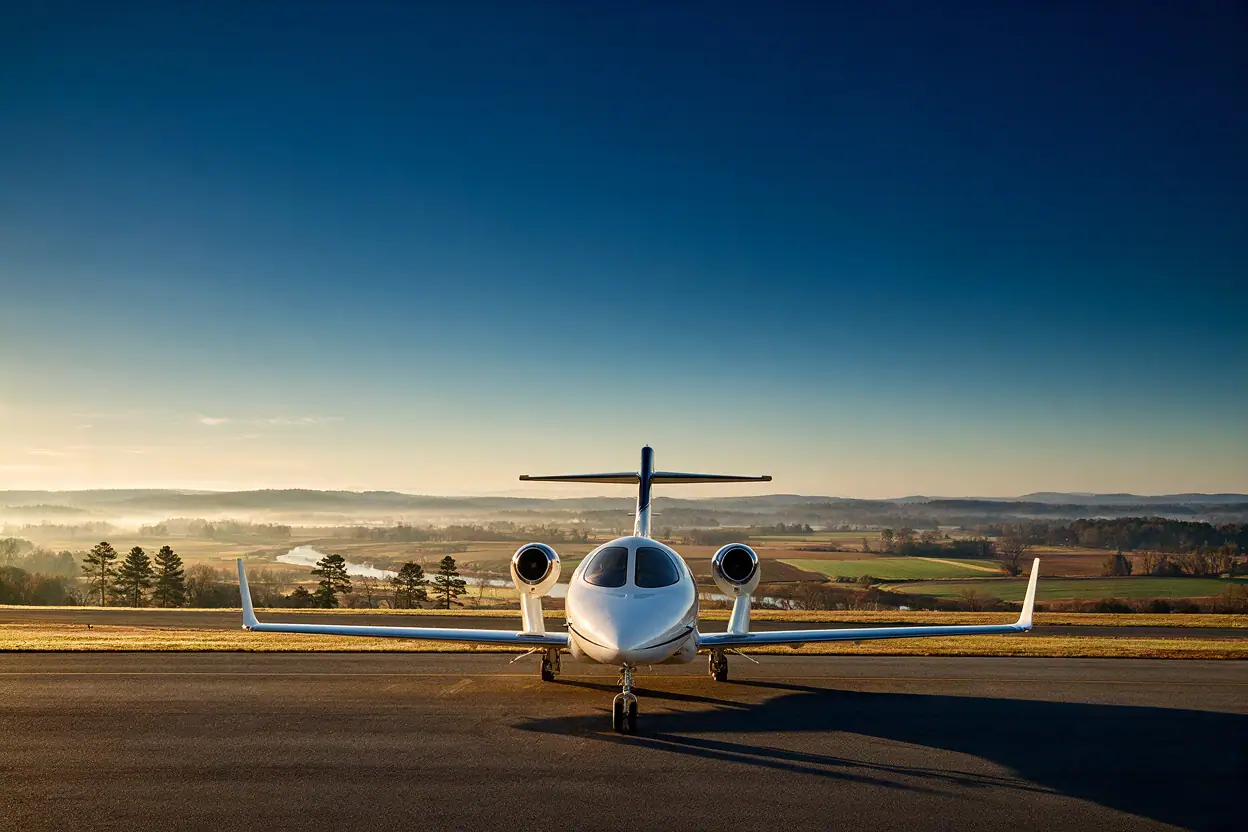
Turboprops fit best on trips that stay inside about 900 nautical miles, where the lower hourly rate still buys a nonstop leg. The samples below use published route distances and quoted time and price ranges for the class, so treat prices as estimates until a specific aircraft and date are quoted.
Turboprop times and rates per route
A turboprop serves these 16 routes in 0h 51m to 8h 30m, and one-way estimates range from $2,200 to $30,000.
| Route | Hours | One-way estimate |
|---|---|---|
| New York → Miami | 3h 37m | $8,000–$12,500 |
| New York → Los Angeles | 8h 30m+ stops | $18,500–$30,000 |
| Los Angeles → Las Vegas | 1h 00m | $2,200–$3,500 |
| New York → Palm Beach | 3h 27m | $7,500–$12,000 |
| Los Angeles → San Francisco | 1h 17m | $3,000–$4,500 |
| Chicago → New York | 2h 28m | $5,500–$8,500 |
| Dallas → Houston | 1h 02m | $2,500–$3,500 |
| Miami → Nassau | 0h 52m | $2,200–$3,500 |
| New York → Boston | 0h 51m | $2,200–$3,500 |
| Washington, DC → New York | 0h 59m | $2,200–$3,500 |
| Los Angeles → Cabo San Lucas | 3h 08m | $7,000–$11,000 |
| Dallas → Las Vegas | 3h 32m | $8,000–$12,500 |
| Chicago → Miami | 3h 53m | $8,500–$13,500 |
| Atlanta → New York | 2h 33m | $5,500–$9,000 |
| New York → Las Vegas | 7h 49m+ stops | $17,000–$27,500 |
| San Francisco → Las Vegas | 1h 33m | $3,500–$5,500 |
FAQ
How much does a turboprop private plane for charter cost per hour?
Hourly rates for a turboprop private plane for charter run about $2,200 to $3,500. A short hop shows the math: Los Angeles to Las Vegas covers 199 nautical miles in about 1h 00m with quotes of $2,200 to $3,500. Longer legs cost more. These are estimates, so ask for a quote that names the aircraft and the date.
How many passengers fit on a turboprop charter?
Most turboprops carry 6 to 8 passengers, and both aircraft on this page seat 6. The PC-12 NGX and TBM 960 each take 6, with baggage space of 40 cu ft and 32 cu ft respectively. If your group is larger than six, then a second aircraft or a jet class is the practical route.
What is the range of a turboprop private plane for charter?
A typical turboprop range is about 1,500 nautical miles, and the PC-12 NGX reaches 1,800 while the TBM 960 reaches 1,730. That covers New York to Miami, 949 nautical miles, nonstop in about 3h 37m. Beyond roughly 1,200 nautical miles, a fuel stop starts to add hours, so compare total time against a jet before booking.
How fast does a turboprop cruise compared with a jet?
The turboprop class cruises around 300 knots, with the TBM 960 at 330 and the PC-12 NGX at 290. That is slower than a jet, but the gap shrinks on short legs. Dallas to Houston covers 208 nautical miles in about 1h 02m, where climb and descent dominate and cruise speed barely matters.
Can a turboprop land at smaller airports than a jet?
Yes, short runways are the class's main advantage. Turboprops need less runway than jets of similar cabin size, which opens county airports, island strips and mountain fields. If the airport nearest your destination has a short runway, then the turboprop may be the only charter class that gets you close without a long drive.
How do I compare turboprop charter quotes fairly?
Ask what each quote includes: fuel, crew, landing fees, de-icing and overnight costs. Hourly ranges of $2,200 to $3,500 can look similar until extras appear. Compare the same aircraft type, the same date and the same airports, and check that the quote is an estimate for a specific tail rather than a class average.